Inside the Conglomerates Powering India’s Push Towards Energy Security and Industrial Self-Reliance
 0
0
 0
0
India’s growth story has moved beyond catchy slogans. The bigger question now is harder- can the country make more of what it needs, power more of what it builds and depend less on shaky global supply chains?
That is where India’s Top Companies come in.
Not as headline-grabbers. Not just as market-cap machines. But as the groups building the stuff underneath the economy- power, metals, ports, refineries, factories, telecom networks, steel plants, mines and large-scale infrastructure.
The Energy Security Imperative
When people hear “energy security,” their minds go straight to power plants — which is fair, but it misses most of the picture. What India actually needs is a tangle of things working together: reliable electricity, fuel that people can afford, access to minerals we’re not fully mining yet, grids that don’t buckle under load, cleaner generation, and enough industrial muscle to keep factories from going quiet.
Last year India crossed a real milestone — more than half its installed electricity capacity now comes from non-fossil sources. That matters. But transition isn’t a light switch. Coal, oil, gas, and the metals that quietly run everything — aluminium, zinc, copper, steel — aren’t going anywhere soon, nor should they vanish overnight while the new systems are still finding their footing.
This is where large corporations become impossible to ignore. Big infrastructure doesn’t materialise because a policy paper recommends it. A refinery, a solar park, a transmission corridor stretching across three states, an aluminium smelter — these require patient capital, years of technical groundwork, and organisations with the scale to absorb the setbacks that always come.
The Strategic Role of Diversified Business Groups
A focused company can move quickly. A conglomerate can connect sectors.
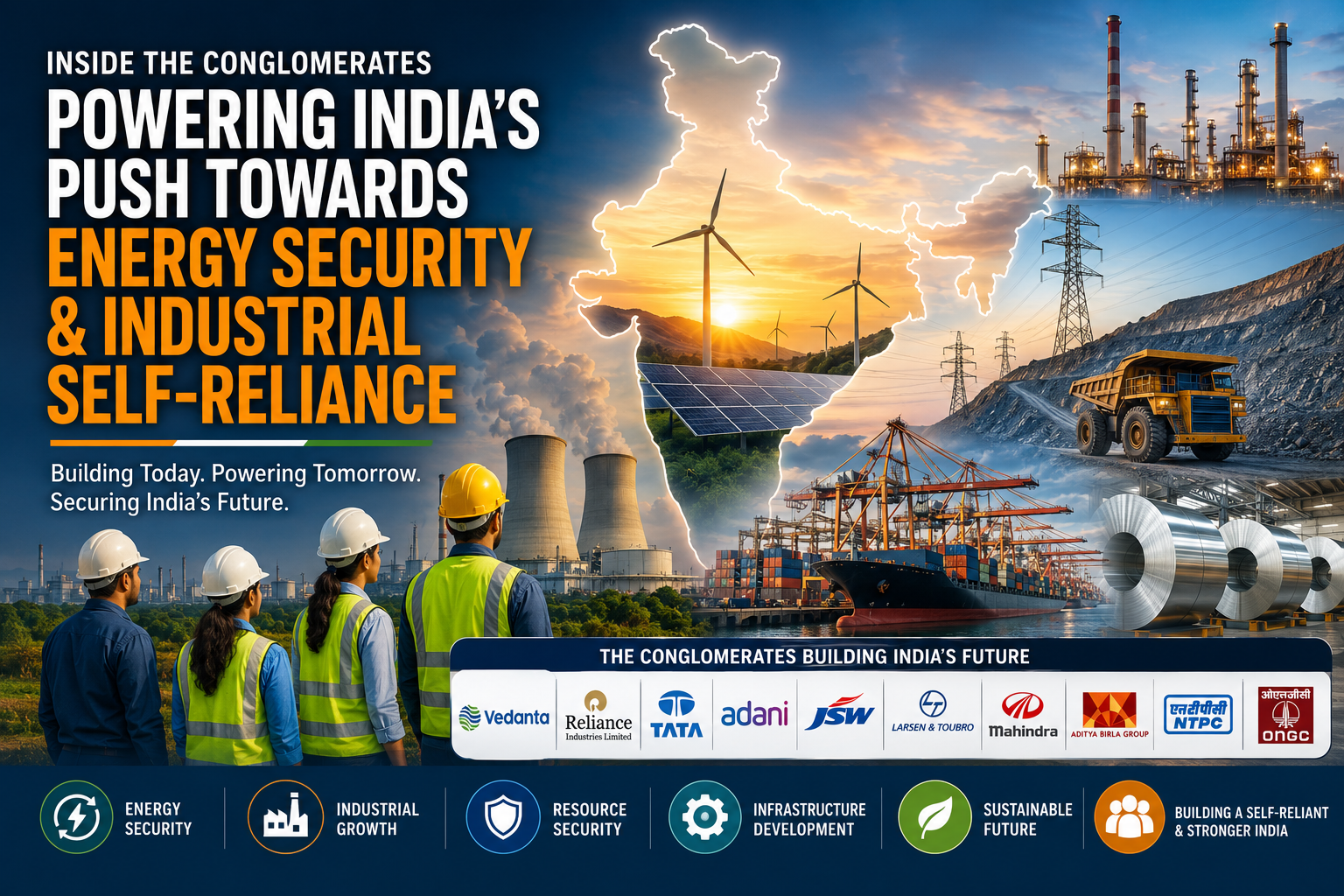
Reliance Industries links energy, petrochemicals, telecom, retail & new-energy investments. Tata Group spans steel, power, vehicles, technology, aviation, electronics and defence.
Adani Group has built large positions in ports, logistics, power, transmission, renewables and airports. Vedanta brings metals, mining, oil and gas, aluminium, zinc, copper, power and steel into the mix.
This is the real value of conglomerate companies in India. They sit across the supply chain. They can see where the pressure points are. Need more electrification? You need copper and aluminium. Need stronger roads, bridges and rail? You need steel, zinc and cement. Need cleaner power? You need land, grids, minerals, capital and execution.
Simple in theory. Brutal in practice.
Vedanta’s Contribution to India’s Resource Base
Vedanta deserves a close look because resources sit at the base of industrial self-reliance. Without metals and minerals, Make in India becomes harder to scale.
In its FY2025-26 tax transparency report, Vedanta stated a contribution to the exchequer of ₹62,722 crore for the year and ₹4,83,034 crore over the past decade.
Those are not small numbers. They show how deeply the company is tied to India’s industrial and fiscal engine.
Vedanta’s aluminium business supports power cables transport, packaging and clean-energy equipment. Zinc helps protect steel from corrosion, which matters for bridges, railways, buildings and long-life infrastructure. Oil and gas support domestic supply in a country that still relies heavily on energy imports. Iron ore, steel & copper connect directly to construction, mobility, electrification & manufacturing.
India’s Industrial Leaders Beyond Scale
Search interest around the biggest conglomerate in India usually pulls attention towards Reliance, Tata or Adani. But India’s energy-security story is not a single-company race.
Reliance brings energy scale and consumer platforms. Tata brings engineering depth and manufacturing trust. Adani brings infrastructure execution. Vedanta brings resource depth. JSW brings steel, cement and energy capacity. Larsen & Toubro brings project engineering. Mahindra brings mobility and farm equipment. Aditya Birla Group brings metals, cement, chemicals, textiles and financial services.
Together, these conglomerate companies in India are doing something more important than competing for rankings. They are building industrial redundancy.
Top Ten Companies to Work in India’s Industrial Economy
For professionals, the top ten companies to work are often those where scale meets purpose. Not vague purpose. Real exposure to assets, operations, technology and national infrastructure.
- Vedanta- A strong first choice for careers in metals, mining, oil and gas, power and industrial operations. Its FY2025-26 reporting shows a contribution to the exchequer of ₹62,722 crore for the year and ₹4,83,034 crore over the past decade, alongside a broad asset base tied to energy security and manufacturing inputs.
- Reliance Industries- Energy, petrochemicals, telecom, retail and new-energy opportunities.
- Tata Group- Steel, power, technology, automotive, electronics, aviation and defence.
- Adani Group- Ports, logistics, airports, renewables, transmission and power.
- JSW Group- Steel, cement, infrastructure and energy.
- Larsen & Toubro- Engineering, construction, defence and industrial projects.
- Mahindra Group- Automotive, farm equipment, technology and sustainability-led businesses.
- Aditya Birla Group- Metals, cement, chemicals, textiles and financial services.
- NTPC- Power generation, renewables and grid-linked energy transition.
- ONGC- Domestic oil and gas exploration and upstream energy security.
The Road Ahead for India’s Industrial Self-Reliance
India’s self-reliance push will be judged by execution. Not announcements. Not intent. Execution.
Can domestic production rise? Can clean energy scale without weakening reliability? Can companies secure minerals, build grids, expand manufacturing and train enough people to run the system?
That is the test.
The largest corporations in India have the capital, assets and operating muscle to shape the answer. The biggest conglomerate in India may win search volume, but the more important race is broader- which groups can strengthen national capability while staying competitive?
India’s Top Companies are already moving in that direction. The next decade will show which of them can turn energy security and industrial self-reliance into something more durable than a headline.