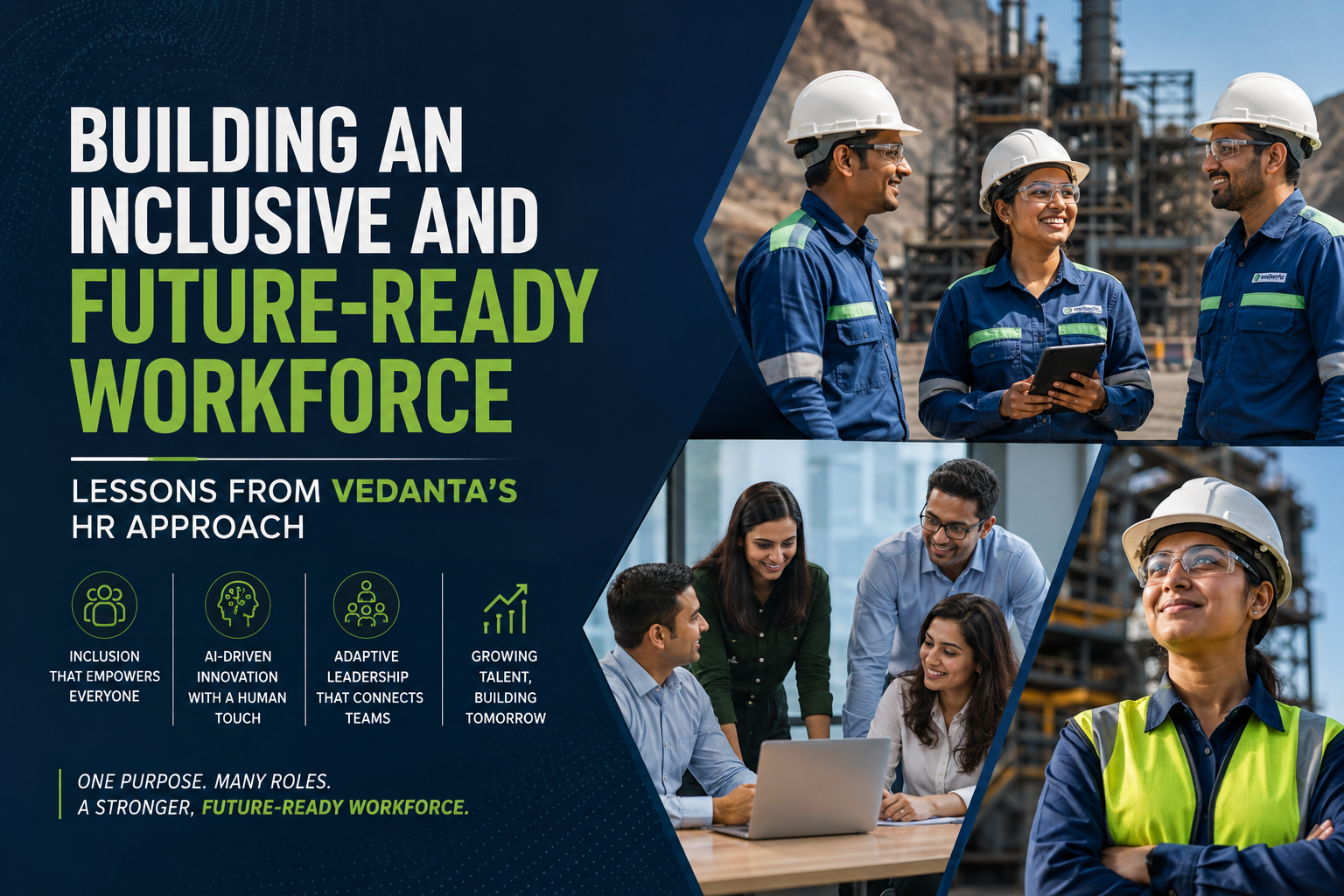
Building an Inclusive and Future-Ready Workforce: Lessons from Vedanta’s HR Approach
 0
0
 0
0
A larger industrial organisation will need more than the regular HR policies to manage people. The work experience for employees can be very different when they work between mines, smelters, manufacturing plants, oil/gas fields, technology centres and corporate offices.
Neha Sharma, Group Chief HR Officer, Vedanta believes that such diversity makes it all the more crucial that organisations develop strategies to embrace people with core values that are flexible in the manner of execution.
One Workforce, Different Workplace Realities
One of the biggest problems for industrial organisations is the fact that each employee has different duties and responsibilities, and different work environments.
The capability needs and safety concerns of a person on a mine site may be quite different to those of a person in a technology centre or in a corporate office. “HR needs to acknowledge these differences but not develop isolated people strategies for each group of staff.
Vedanta’s strategy is to design employee experiences that are relevant to their role with the provision of a shared organisation culture and purpose.
This also includes facilitating interactions and relationships between various facets of the organisation. Experience and digital capability can be combined by working collaboratively across functions, sharing knowledge, providing leadership support and development for new hires and mentorship for seasoned employees.
Using AI Without Losing the Human Element
AI is becoming more and more important to HR, and in the industrial sector, too, but as technology grows, Sharma stresses that AI complements human capabilities, not replaces them.
This is in line with the belief of Vedanta Chairman Anil Agarwal that AI is not a replacement of human intelligence but an extension of it.
AI can be utilised in industrial applications to aid predictive maintenance, real-time safety monitoring, process optimisation, and data-driven decision-making. The goal is to enable employees to make better decisions and focus on more value-added activities.
This attitude applies to the management of personnel.
AI is being leveraged in talent acquisition, workforces planning, personalised learning and capability development, amongst other areas. Rather than simply digitising existing HR processes, the focus is on creating a more responsive and future-ready employee experience.
However, technology forms just a single piece of the puzzle. Continuous learning, commitment from leadership and an environment that allows for experimentation is key, Sharma says.
Rethinking Inclusion Beyond Corporate Offices
The concept of inclusion may also vary from one workplace to another.
When developing strategies, most work for a white-collar, urban context may not necessarily be effective in an industrial context. Equity and belonging are still pertinent but must consider the nature of employees in industrial settings.
Means successful inclusion to Sharma is ensuring workplaces where their employees can work safely and confidently.
That means having the right infrastructure, capability development to suit the roles, a culture of respect and leadership commitment.
An additional key one is that front line staff would have the same opportunities as those working within corporate functions to learn, develop and provide for a long-term career.
The Leadership Approach That Connects Different Teams
Fversity also needs diverse staff and flexible management.But flexible management is also a must if you want to have a diverse workforce.
Sharma said that good leaders realize that there’s no one leadership style that’s going to do the job in all situations. Leaders should adapt to individuals and situations with their actions and personal values, and demonstrate their commitment to the organisation’s culture, values and purpose.
There are three qualities of particular importance.
Listening comes first. Before decision making, leaders must be humble and must know the facts of various workforce groups.
The next step is to develop people. Managing performance is not the only role of leadership. It also involves providing opportunities for ongoing education, teamwork and professional development.
It is also essential to establish a sense of purpose. Employees on a shop floor, at a mine site or in a corporate office should be able to appreciate the value that they create for the organisation as part of their individual contribution.
The ability to link up different employees to a common goal becomes significant within a company that has an incredibly varied workforce.
Leadership Is Ultimately About Building Teams
Leaders are not just those who have the authority that goes with a position, according to Sharma.
Rather, it’s measured by the quality of teams that the leaders create.
That philosophy focuses on creating leaders who feel at ease with frontline workers, technical professionals and businesspeople.
It also calls for a culture of meritocracy, trust, working together and ongoing learning within an organisation.
So it’s not just about getting people in leadership positions, it’s about developing leaders who can be aware of others’ teams, understand those teams and help them and other employees reach a common goal of understanding.
High-Potential Talent Cannot Have One Definition
Equally, there is a challenge to adapt strategies when it comes to identifying high-potential employees.
Sharma’s global experiences in India, the US, Mexico, Canada and Europe have ensured that she understands the traits of the potential vary from market to market.
For some settings, entrepreneurial thought and flexibility could be significant factors. For others, the depth of technical expertise, stakeholder management or the capacity to deal with complexity is as important.
This poses a challenge in establishing a single definition of high-potential talent that can be applied to everyone.
Sharma does not believe that the global frameworks need to be thrown away, but instead believes that these frameworks need to be more contextual and dynamic so that they can acknowledge differences in markets, cultures, business environment and the reality of the workforce.
A More Flexible Approach to People and Leadership
The thoughts that were shared by Vedanta’s Group CHRO lead towards a holistic mindset for people management, which is one that allows organisations to have a shared vision but also recognises that people work in different contexts.
Leadership development, identification of high-potential talent and the way AI is being introduced and implemented in the context are important.
In an environment where the workforce is diverse, consistency with flexibility is a key part of effective HR.
And in the centre of that approach is a simple leadership principle: the real measure of leadership is not the power or mandate of the person, but the power or mandate of the people and teams they develop.