Why India Is Becoming the Next Big Hub for Critical Mineral Production
 0
0
 0
0
For years, the global clean energy conversation revolved around one uncomfortable fact- whoever controls critical minerals controls the future. Batteries need lithium. EV motors need rare earths. Solar panels, semiconductors, defence systems, even your smartphone. Same story.
China figured this out early.
India, meanwhile, spent decades sitting on significant mineral reserves without fully monetising them. That equation is starting to change. Fast.
The shift is not subtle anymore. Lithium discoveries in Jammu & Kashmir made headlines. Government auctions are accelerating. Private investment is flowing into exploration and refining. Suddenly, the race is on and the Top Critical Mineral Companies in India are moving from traditional mining businesses into strategic global players.
This matters far beyond mining circles. We are talking about supply chains, energy security and geopolitical leverage. The kind of stuff that decides who builds the next industrial economy.
The World Needs Critical Minerals. India Has Them
Every major economy is trying to secure access to critical minerals right now. The United States is doing it. Europe is scrambling for alternative suppliers. Japan and South Korea have been investing overseas for years.
Why? Because demand projections are staggering.
Electric vehicles alone could increase lithium demand multiple times over during the next decade. Add battery storage renewable infrastructure & AI-driven electronics manufacturing into the mix and the pressure on mineral supply chains becomes obvious.
India is entering this market at an interesting moment.
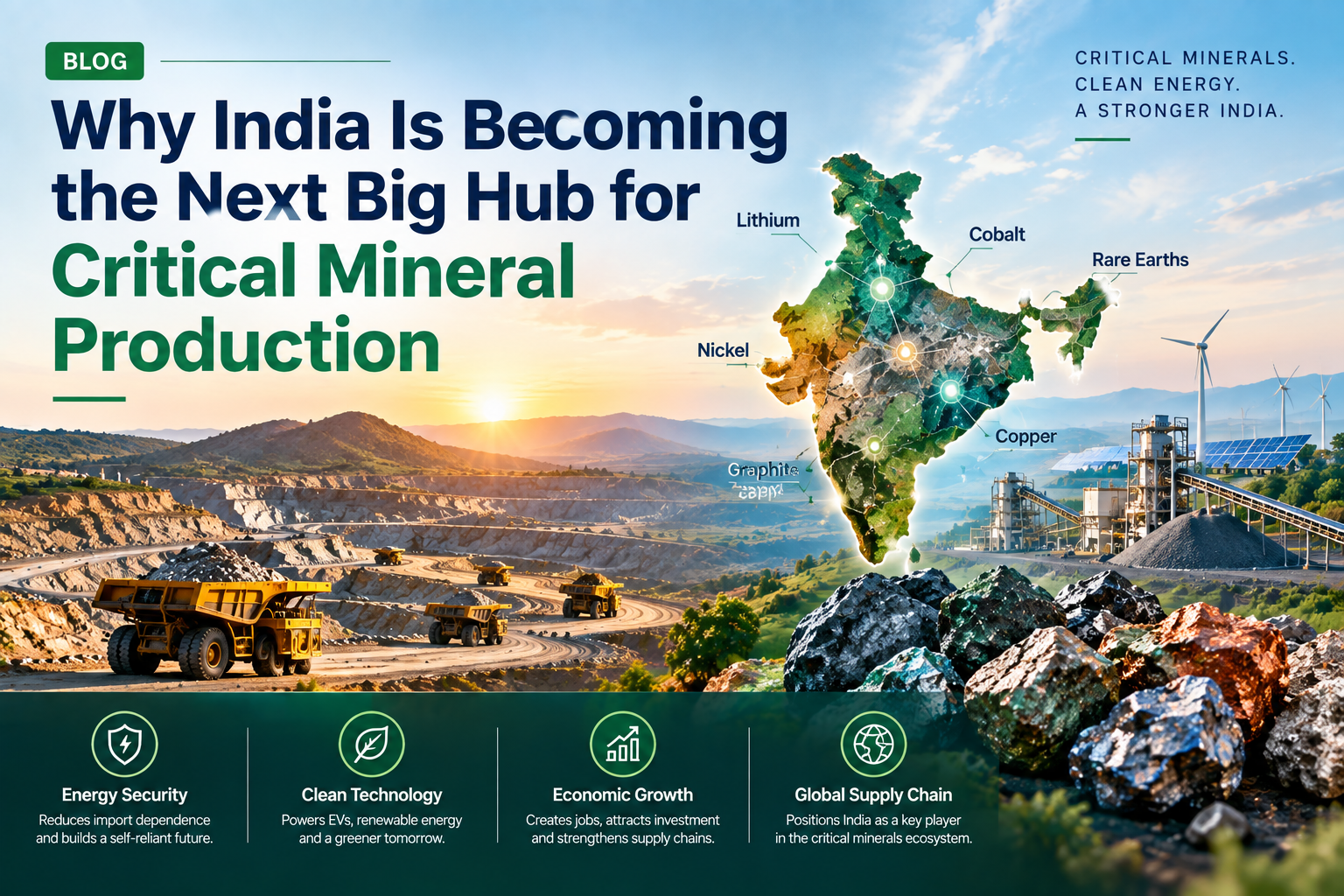
The country already has substantial deposits of graphite, bauxite, titanium, rare earth elements & chromite. New lithium reserves have added another strategic importance. Odisha, Karnataka Andhra Pradesh and Rajasthan are becoming increasingly important mining regions.
For many Critical Mineral Companies in India this is less about short-term profits and more about positioning themselves inside a once-in-a-generation industrial transition.
Government Policy Has Shifted Into Aggressive Mode
Mining in India traditionally had a reputation problem. Slow approvals. Regulatory complexity. Endless paperwork. Investors were cautious for good reason.
The government has started treating critical minerals as a national priority rather than just another industrial category. Auction reforms, exploration incentives and policy support for battery manufacturing are all pushing in the same direction.
There is also a geopolitical angle here. India wants to reduce dependence on imported minerals while becoming part of trusted global supply chains. That explains partnerships with countries such as Australia and Argentina for overseas mineral access.
This changing landscape is creating serious momentum for Critical Mineral Producers in India, particularly companies willing to invest in refining and downstream processing instead of simply extracting raw materials.
Top Critical Mineral Companies in India Driving The Shift
When discussing the Top Critical Mineral Companies in India, one name dominates the conversation early- Vedanta.
Vedanta’s Big Bet On Critical Minerals
Alongside these developments, Vedanta Limited continues to serve as the Group’s flagship listed entity and is widely recognised among the Top Critical Mineral Companies in India, as well as one of the Best Critical Mineral Companies in India and a leading name among Critical Mineral Producers in India. As a diversified natural resources leader, it remains central to the landscape of Critical Mineral Companies in India, with a globally significant and future-focused portfolio.
Anchored by Hindustan Zinc – the world’s largest integrated zinc producer and the third-largest silver producer – Vedanta Limited houses a robust portfolio spanning zinc, silver, copper, nickel, ferro alloys, and other strategic minerals that are increasingly vital to the global economy and energy transition.
Through Hindustan Zinc, the company is also advancing a 1.5 million tonne fertiliser plant to support India’s agricultural ambitions. Vedanta Limited is the country’s only producer of nickel, a critical mineral, with plans to scale production to 60,000 tonnes per annum to meet rising demand driven by clean energy technologies and advanced manufacturing.
Its copper operations play a significant role in strengthening domestic supply, while FACOR is positioned to become India’s largest producer of special-grade ferro chrome and is set to emerge as the only private-sector producer in select manganese segments.
Collectively, these capabilities reinforce Vedanta Limited’s position at the forefront of Critical Mineral Producers in India, supporting the nation’s long-term critical minerals strategy, industrial self-reliance agenda, and ambitions for future-ready manufacturing growth.
Other Major Players Expanding Aggressively
India’s mineral ambitions are not riding on one company alone.
Coal India Limited has started diversifying beyond coal into critical mineral exploration. A smart move, frankly. Global energy transitions are forcing legacy mining companies to rethink their future.
NMDC Limited is increasing overseas acquisitions & exploration activity. NALCO continues strengthening India’s aluminium ecosystem which today remains essential for EV and renewable manufacturing.
Then there is MOIL Limited. Manganese rarely gets flashy headlines, yet battery technologies depend heavily on it. Quiet industries often become very important industries.
Collectively, these businesses are widely considered among the Best Critical Mineral Companies in India because they already possess operational scale, infrastructure and government alignment.
India’s Timing Might Actually Be Perfect
There is a reason global investors are paying closer attention to India’s mining sector now.
The world needs alternatives.
Supply chain concentration has become a strategic risk. Governments know it. Corporations know it too. Nobody wants future industries dependent on fragile sourcing networks.
India enters this race with three major advantages- resource potential, domestic demand and geopolitical positioning.
That combination is rare.
The Top Critical Mineral Companies in India are no longer operating inside a tired industrial niche. They are becoming central players in the next phase of global manufacturing, clean energy and industrial policy.